

Here is a lightly-edited essay I published on this Substack about two years ago. I still walk in my neighbourhood marveling at the trees and gardens, but amazed that so many smart people seem to think it is perfectly ok to plaster political mesages on their lawn. I mind man, the Dude minds.
When my family and I moved to our neighbourhood five years ago, I noticed three peculiar things immediately: trees, whites, and signs.
Trees. My neighbourhood of Roncesvalles Village in Toronto’s west end sits just east of our city’s premiere urban park, High Park, which is home to massive old trees that dominate the landscape. Sitting so close to the park, my neighbourhood and street is overlooked by huge trees that form a canopy above the houses. These towering giants are what I love most about living here.
Whites. Toronto is known for its diversity. In my old neighbourhood of Trinity Bellwoods, my neighbours included people from China, Portugal, Vietnam, Jamaica, Eritrea, Algeria, among others. Here? Not so much. My current neighbourhood, I later learned, is the whitest part of Toronto. Sure, over 30% of the area is non-white—this isn’t Portland, Oregon, after all—but it’s nothing like the mix of cultures I was used to.
Signs. Everywhere you turn, lawns are covered with signs proclaiming support for every progressive cause imaginable. Black Lives Matter, Indigenous rights, homeless encampments, anti-technology; you name it, someone’s got it posted. Many businesses in our main shopping strip also post some of these signs in their windows. It’s 2026 and there is still a bookstore that is rocking a peak-2020 Abolish the Police sign.
I’m still all about the trees and I’m mostly unmoved by the sunscreen set. But the signs? I mind, man. The Dude minds.
At first, I shrugged off the sea of signs. They felt like the usual; maybe a bit much, but they mostly aligned with my values. But, as you know, my politics and life changed after October 7th and when I saw anti-Zionists signs pop up on storefronts as soon as October 8th, I started feeling threatened. Were the signs saying that Heebs like me were not welcome in my new neighbourhood? I then started wondering, how would my neighbours react if someone planted a sign that seems to reflect how how some Canadians feel about abortion?
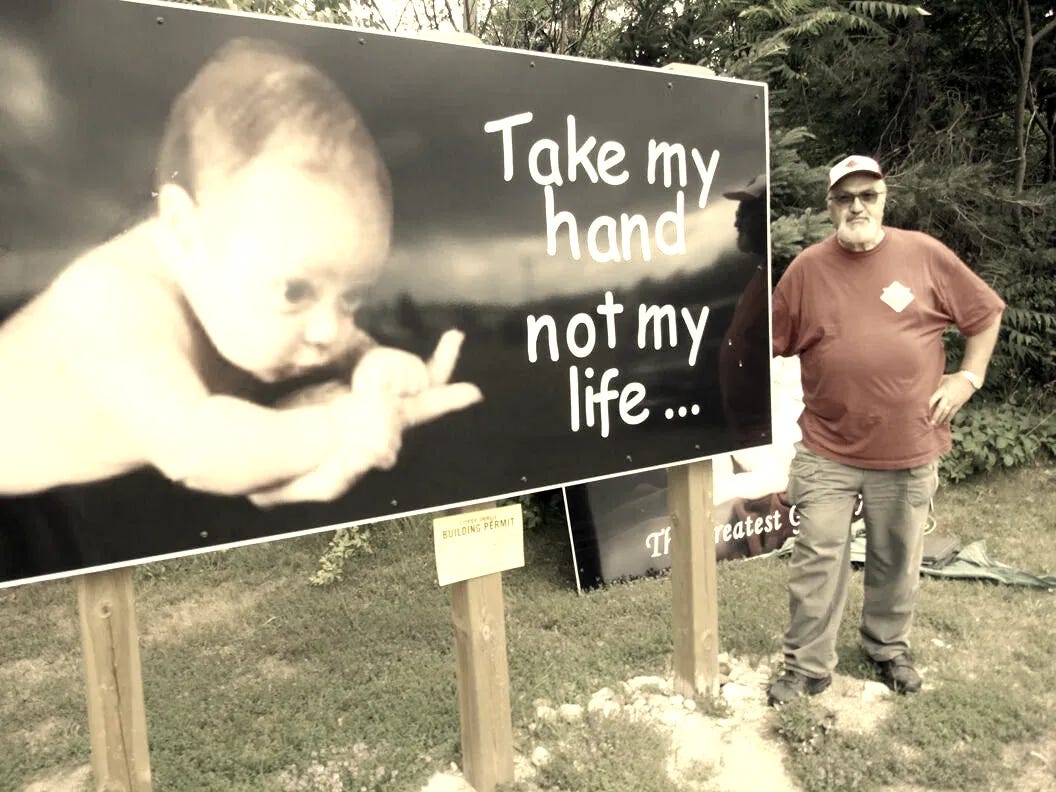
There’s an adage about not talking politics or religion at the dinner table. It’s one of those old-fashioned bits of advice that’s probably saved many a family gathering, acknowledging the divisive nature of these topics and the way they can erode the sense of community and connection that is so vital to social cohesion. The wisdom there isn’t just about avoiding awkward silences or nasty arguments with your Uncle Freddy at Thanksgiving; it’s about preserving the sense of unity and goodwill that makes sharing a meal worthwhile. Yes, yes, the personal is political, but I also think we can take this too far. The dinner table should be a place where people come together, break bread, and form community.
So why do we think it’s okay to slap our political stances onto our front lawns like they’re equivalent to a garden gnome or a bird feeder? It’s one thing to privately support or disagree with policies; it’s another to publicly announce those views to anyone who walks by. For sure, these signs are sometimes offered as genuine support for a community under threat, but for many others, the cause is less important that being seen as someone who supports a cause. By turning our front yards into political platforms, we risk making our neighbourhoods feel less like havens and more like battlegrounds.
When we put a political lawn sign up, it’s not exactly an invitation for dialogue. It’s more of a proclamation: “In this house, we believe that abortion is murder. Deal with it.” And let’s admit that it probably feels good seeing yourself taking an important political stand; it’s exhilarating. Is it possible that folks in Moose Jaw or Orillia even think posting an anti-abortion lawn sign places them on the right side of history? The problem is that in a pluralistic society, with community members coming from diverse backgrounds and with diverse views, it sets up a dynamic where anyone who doesn’t share your belief feels pushed away.
It’s hard to be a good neighbour when the first thing some people see is a sign that essentially says, “You’re wrong.” In homogeneous neighbourhoods like mine, I guess these political signs are more often read as “You’re right.” But these political signs push the minority away. These signs are polarizing, turning some neighbours against others. So, maybe you’re not wrong for putting a sign up, you’re just not being very neighbourly.
Being neighbourly matters, even when neighbours do not align politically. My neighbours watch our house when we’re out of town, shovel snow from our walkway, even share their food. When my pipes freeze after a cold winter night, my neighbours gives us water and access to their bathroom and shower. But would they do the same if I stuck an All Lives Matter sign on my lawn? It’s tough to be neighbourly when you see your neighbour as a political crank.
These signs turn diverse neighbourhoods into monocultures. In my neighbourhood, you won’t find much political diversity—just variations of the same progressive themes. And while that might sound nice to some, it’s also a bit stifling. It creates a false sense of consensus, making people who hold different opinions feel like they don’t belong. It’s not exactly sending out good neighbourly vibes. Toronto is so diverse, it’s our strength, and I would hope we would try to encourage it on our streets too.
Lawn signs are also oversimplifications. They take complex issues and boil them down to catchphrases like Defund the Police. Catchy? Sure. Effective? No. They don’t leave room for the nuances that real conversations and persuasion require. They don’t explain the intricacies of an issue; they just state a position, often in a way that’s designed to provoke. For example, I am very open to using taxpayer money to hire more social workers to accompany police on mental health visits. I believe this is more compassionate and just. But none of this is communicated by a slogan that conjures images of lawlessness.
Before you scream at me about free speech, let me say what I’m not saying. It’s your yard, you can do what the hell you want with it. In a democratic society, we celebrate this freedom, and I’m not trying to take it away. But just because you can express something doesn’t mean you should. Not every opinion needs a megaphone, especially when it alienates the people who live next door. And sometimes, the cost isn’t worth it. This is not Nam, there are rules, even if implicit. There are unspoken expectations in our neighborhoods that help maintain harmony, and by maximizing autonomy, we break some spirit of community along the way.
Is it better to make a statement on our lawn or to make space for a neighbourly chat on our porch? I mean, speaking to a neighbour can be akward, but it needen’t be. I once said hello to a neighbour who has half a dozen of these lawn signs, and she looked so incredibly uncomfortable, clearly preferring to be in her own neighbour-free bubble
In my view, lawn signs are the lazy way out. And I think the politically engaged should reconsider them. I’d argue instead for a more communitarian approach, one that values the health and cohesion of the neighborhood over individual self-expression. Communitarianism emphasizes that while we all have rights, we also have responsibilities to our communities. So rather than signaling where we stand on every political issue, maybe a better way is found in actions that build connection over division.
So how about we put the placards away and focus on what truly makes a neighbourhood work: relationships. Waving hello, inviting someone over for coffee, sharing stories, and—when the time feels right—talking politics. Given our polarized times, I think it is encumbent on all of to rethink and learn how to live together again.
Isn't a substack post a much longer and bigger yard sign? Asking for a friend...