

When I saw a fancy professor put an award he won in a desk drawer, I was surprised. Weren't these plaques meant to be displayed? I guess it could come off as immodest, but then why was it normal for doctors and dentists and optometrists to prominently display their credentials? I was confused and still am a bit. I wrote a bit about it last year and now I am republishing it here without a paywall. Enjoy!
My mom’s plaques hung in a prominent spot in our family room. There were two of them. Both had walnut wood backings, one of them with blue painted metal engraved with my mother’s name, and the other with gold painted metal. The plaques commemorated my mother’s volunteer work for the annual synagogue bazaar, acknowledging her contributions. That’s it. But to me, they were sources of awe and inspiration.
In a home where no one had diplomas, never mind diplomas hung on walls—where there were no outward signs of achievement at all—those synagogue plaques meant the world to me. It meant that that my mom mattered.
Growing up, I wanted a plaque with my name on it. It wanted to me like my mom.

When I graduated high school and later McGill, my parents were very proud. They insisted on framing my diplomas and hanging them up for all to see. I was now one of those fancy people who had a degree. And I too was proud.
I went on to earn more degrees and even more diplomas. I even won a few awards and was ceremonially bestowed with the same sort of walnut and metal plaque engraved with my name; just like my mom. I was proud of these, too.
So, when I landed my job as a professor, I did what I thought all degreed professionals do: I hung up my diplomas and awards in my university office, like I’d seen in the countless doctor’s offices of my youth. I mean, we’re given these ornate degrees, they’re meant to be displayed, right?
Wrong.
It took me well over a decade to figure this out, but no: professors of any worth do not hang up their diplomas. And they definitely don’t hang up any awards. Those are meant to be hidden in a closet.
I never received the secret message about elite etiquette around diplomas and awards, but most of my colleagues seemed to know. It was some unwritten rule they had internalized. Maybe they knew because so many professors are the sons and daughters of professors themselves—I know more than a few who are third-generation egghead. For them, a diploma isn't a big deal because everyone in their family has one. It would be like the granddaughter of a billionaire hanging up the first five-dollar bill she ever earned.
But this isn't just an academic thing. The wealthy, across all domains, understand the perceived boorishness of displaying credentials. When you are certified elite, you don't need to signal that to the world. In fact, not hanging up the diploma is the real signal, something a bit like that obnoxious trend of quiet luxury.
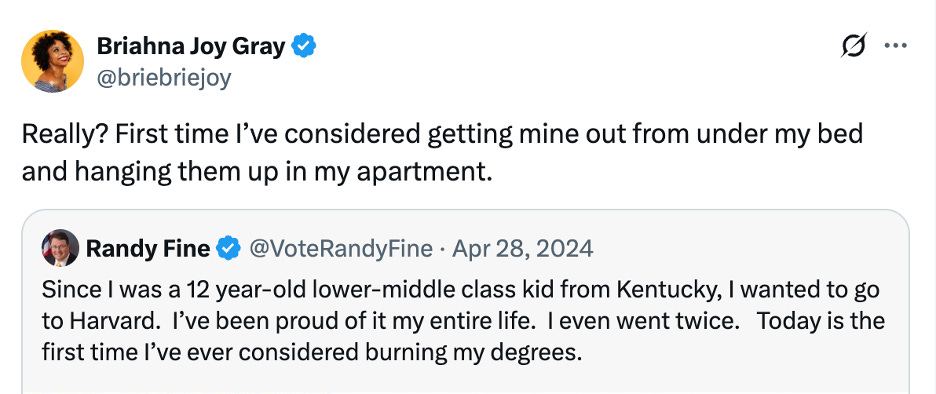
I saw this dynamic play out perfectly on social media about two years ago. When a conservative American politician tweeted about considering taking down his Harvard diploma because he was ashamed about the latest academic provocation, Briahna Joy Gray—Bernie Sanders' former campaign manager and champagne socialist—responded that she might finally dust off her own Harvard diploma from under her bed and hang it up. Apparently she is so comfortable being an elite that her diploma has been literally gathering dust under her bed.
There's research backing up this intuition. According to symbolic self-completion theory, when people are uncertain about their identity or status in a particular domain, they compensate by displaying symbols associated with that identity. My friend Cindy Harmon-Jones tested this theory in academia by examining how professors and departments display professional titles on their websites. In their studies, they found that academic departments with lower national rankings were more likely to list professional titles like "Dr." or "Ph.D." on their websites, while higher-ranked departments often listed faculty by name alone. At the individual level, professors with fewer publications and citations were more likely to include professional titles in their email signatures compared to their more productive colleagues.
The principle extends to diploma-hanging, and it's not just about institutional prestige: it's about class background, insecurity, and signaling versus countersignaling, too. At its core, symbolic self-completion theory is about who feels secure in their belonging and who doesn't. The Harvard folks know they're part of the elite club and are secure enough to countersignal. Their diplomas can gather dust because their status has not been questioned.
Meanwhile, those from less prestigious institutions or from working-class backgrounds engage in signaling to prove to others (and possibly themselves) that they belong. For first-generation college students, these credentials represent something that deserves recognition, but also serve as reassurance that we've earned our place.
That need to prove I belong became painfully clear during my second year of grad school at Brown. There was this cognitive science seminar where not only students attended, but all the department’s professors too. I didn't say a word the entire semester. I was petrified. I sat there convinced that someone would eventually discover they'd let me in by accident, that my advisor had been desperate in accepting me. After all, Brown was the only school that accepted me. Yes, other students and professors experience imposter syndrome too, but if your parents are professors, you have someone to call who has been through this to talk things through. I didn't have that. My parents were just proud they'd soon have someone in the family who could use the title doctor.
What strikes me is how I got things backward. I was signaling my outsider status by hanging up my diplomas. I was doing what first-generation college students do: I treated my diploma as a coveted treasure.
This signaling creates another barrier for people like me. Not only do we have to earn the thing, we have to learn how to be blase about it too. This drives me nuts. Hanging up your diploma shows you’re honest about what you're proud of. And elite indifference is simply downplaying priviledge.
I care about my achievements. I'm proud of them. My family is proud of them. Those plaques meant something to my mom and they mean something to me. So yeah, my diplomas are still hanging in my office. And if that makes me déclassé in the eyes of my colleagues, fine. I display my diplomas because getting them transformed my life, and I'm not going to pretend otherwise. After all, I am testament that the bums don’t always lose.
Great post. I know a man who routinely walks into rooms full of senior leaders in ill-fitting and crumpled clothes and still manages to impress everyone. What this tells me is not that he is particularly brilliant (although he is) or particularly laid back. What this tells me is that he is so completely secure in his own belonging in that room that he knows they will take him seriously no matter what he wears. That security is the definition of privilege.
Whereas women, people with a different accent, people from a different social class, anyone who doesn't look like they were born to sit in that room, learn that they do have to dress the part or use the title, not necessarily because they care more about status, but because they have found through experience that people just look through them if they don’t. You can call it insecurity or poor taste but I think it's often just an adaptation to how the world responds.