

There’s been lots of talk about race in academia in the news cycle…again.
First, Tyler Austin Harper wrote the cover story for the Atlantic about his experience as a Black professor at a small liberal arts college in Maine. As he tells it, he was hired less because he was an expert in his topic area and a great teacher and mentor, and more because he was Black. Harper was more or less ok with being the beneficiary of affirmative action until he realized that his hiring also meant that he needed to go along with certain views and politics too. The price for entry into the elite was adherence to a specific brand of progressive politics. And when he refused to do that, he was no longer viewed as the right kind of Black. Harper eventually quit his plum appointment because he could not be his full self, he could no longer breathe.
Second, and more tragic, is the story of former Cambridge professor Jason Arday, who was hired to great fanfare as the youngest ever Black professor in Cambridge’s illustrious history. Much has been said about his story, so here is the short version. Arday was also a diversity hire, but unlike Harper, he was a fraud. It turned out he was not only a plagiarist, he also lied about nearly every part of his backstory. How could Cambridge have let this happen? One simple answer is that the administrators at Cambridge were too worried about how they would appear asking hard questions of a celebrated Black hire, they were anxious about what it would look like to “punch down”. It was only when Arday’s obvious fabrications were too hard to ignore, that Cambridge stopped shielding him and stopped treating the reporters who asked questions as the problem. Arday resigned in disgrace and was found dead nine days later.
Like I said, this was a tragic story. Last year I published a paid post with my own take on how our society has decided to treat race. I thought we made grave mistakes, and I wish the last few weeks had proven me wrong. I’ve decided to republish the essay here, now with the paywall removed. Please tell me what you think.
What if trying to fight racism made it worse?
I know how that sounds. But hear me out. Hate crimes in the U.S. have surged over the past 15 years, targeting Black people, Jews, LGBTQ folks, Arabs, Latinos, pretty much every protected group you can name. The same pattern shows up in Canada, despite our reputation for being nice…and boring. There are obviously multiple causes, but I can't shake the feeling that our shift toward aggressive anti-racism messaging might be one of them.
And this isn’t just me being anti-woke. I got into social psychology specifically to reduce prejudice, and my dissertation was about the educational experiences of marginalized groups. So I care about diversity, but research I conducted over a decade ago suggests that coercive approaches to fighting bias can backfire.
Traditional approaches to fighting racism focusing on non-discrimination and colorblind ideals gave way to something more vocal and aggressive. The new anti-racism framework demanded active participation. It wasn't enough to avoid being prejudiced; you had to actively dismantle bias to create more equitable outcomes. Fair enough: systemic racism is real and persistent.
But then something changed. I found myself increasingly at odds with the modern anti-racism movement. The tenor of the movement became more aggressive, less tolerant. Some of the methods used to reduce prejudice relied heavily on public accountability and social pressure, creating approaches that felt coercive while leaving little room for grace.
That's when the movement lost me. And if it can lose someone who spent 15 years teaching about prejudice, imagine how normies would react.
How could they lose me? Research I conducted over a decade ago, with my former students Lisa Legault and Jennifer Gutsell, now both tenured professors, offers clues. Back in 2011, we published a paper on prejudice reduction. Our goal was to see if we could reduce bias by working with people's intrinsic motivations rather than against them.
We created two different pamphlets framed as part of a new campus initiative. The intrinsic motivation pamphlet encouraged participants to see the personal value of diversity, emphasizing choice and explaining why prejudice reduction was important and worthwhile for them personally. The extrinsic motivation pamphlet used the language of prejudice-reduction that was common on campus in the late 2000s. It urged participants to “combat prejudice” and comply with social requirements to control stereotypical impulses, using terms like “erase racism” and “stop prejudice.” We also had a third group that received no pamphlet at all, our control group. We measured participants' anti-Black attitudes, which captured subtle modern prejudices like believing anti-Black prejudice is over-exaggerated or that Black people are demanding too much.
We predicted that the intrinsic messages would work better than the controlling approach, which we expected would still reduce prejudice more than doing nothing. What we found surprised us.
Yes, the intrinsic messages reduced prejudice compared to the control group. But what really stood out was that the pamphlet with the then-current anti-prejudice messages—the more coercive approach—actually increased prejudice compared to doing nothing at all.
We didn't believe the results at first, so we ran a second study and replicated the same pattern: positive effects for the intrinsic approach, but a clear backfiring effect for what we might now recognize (by today’s standards) as mild anti-racism messaging. As far as I know no one has replicated this work, and samples are small as was the custom in pre-replication crisis social psychology; so treat these results as provisional. Nonetheless, when looking back now, I think we accidentally discovered something interesting, man.
Fast forward to 2020, when anti-racism became a dominant framework for addressing racial inequality. At its core, anti-racism makes arguments rooted in the work of scholars like Ibram X. Kendi and Robin DiAngelo. As Kendi argues, “One either allows racial inequities to persevere, as a racist, or confronts racial inequities, as an antiracist.” In this view, passive non-discrimination isn't enough. The framework requires a commitment to actively fighting racism; if someone chooses the path of non-prejudice or non-racism, they are unwittingly supporting passive racism.
The core insights behind anti-racism have some merit. I’m convinced that forms of racism are embedded in some institutions and policies. I’m even more convinced that ostensibly neutral practices can maintain inequalities, even if inadverdent. These are important observations.
But…
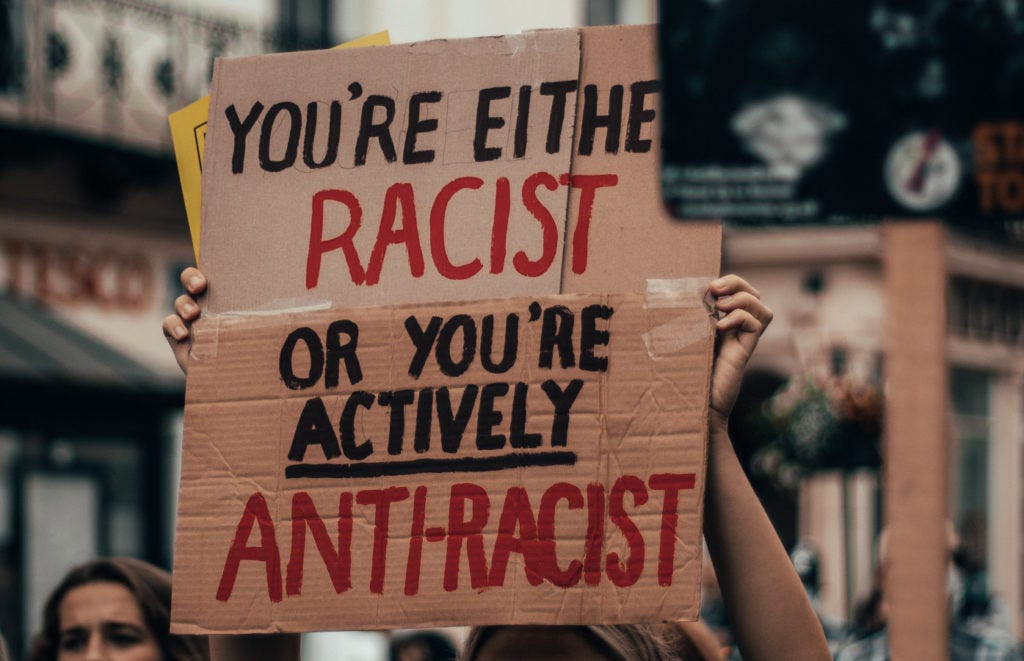
For reasons unknown to me, practitioners of anti-racism adopted a coercive, heavy-handed approach. The message became clear: If you're not actively fighting racism, you are racist and any hesitation to embrace the framework makes you part of the problem. This approach manifested in mandatory corporate diversity training and diversity statements, public shaming for even simple mistakes or misunderstandings, and attempts to get people fired or not hired for opinions that went counter to the anti-racist approach.
This is exactly the kind of controlling, coercive messaging that our research showed can backfire. And more applied research confirms our surprising findings. Sociologists Frank Dobbin and Alexandra Kalev discuss how people often respond to mandatory diversity programs with anger and resistance, with many participants reporting more racist attitudes, not less. Diversity training is especially ineffective when it requires mandatory participation. This makes sense: when you tell people they have no choice but to think a certain way, people push back.
Want to see this dynamic in action? Let me tell you what happened to a colleague of mine when she gave a talk at a major psychology conference. This incident perfectly captures how anti-racist vigilance can spiral into something destructive and perhaps even undermine support for prejudice reduction more broadly.
What happened to her is both infuriating and instructive. It involves Bernie Sanders, Kanye West, a single complaint, and administrators who chose public shaming over private resolution. It's the kind of insider academic drama that illustrates what’s wrong with how we're approaching prejudice reduction today.
The colleague is my friend Jessica Tracy, a social-personality psychologist at UBC, when she won the Career Trajectory Award at the 2021 meeting of the Society for Experimental Social Psychology in Santa Barbara, California. The award is perhaps our field’s top honour for early-to-mid career researchers. (Full disclosure: when I was younger, I dreamed of winning this award, even imagining my acceptance speech where I’d break down in tears thanking my mom. I never won and never gave that speech.) The award is a big deal, so is that speech, and so is Tracy.
In her acceptance speech, Tracy talked about her research on pride and presented photos of Bernie Sanders and Kanye West. She used Sanders' photo to illustrate the nonverbal expression of pride in general. Nothing controversial so far. She then transitioned to discuss her research on the two different types of pride, using West as an example of what she calls hubristic pride, a grandiose form of pride associated with self-aggrandizement.
Do any of you see Tracy’s sin?
How dare Tracy use a Black man as an example of hubristic pride! Apparently one person complained about Tracy's choice of image—boy, would I love to know who this is—and the executive committee of the society sent a statement to all members more-or-less calling her presentation racist.
I’ve since learned that Tracy and the complainant had already resolved the issue directly, with the complainant accepting her personal apology and saying nothing more needed to happen. But the executive committee insisted on making a public statement anyway. I have no idea why they could not recognize this as a minor issue resolved between two professionals, but I suspect that they were too scared of appearing insufficiently anti-racist. Her life was in their hands, and they chose to sully her reputation over what was, at worst, an unfortunate choice of examples. Strike that. It takes a complete lack of grace to construe what Tracy did as wrong, and the executive committee should have known that. If you ask me, they owe her a public apology.
This is the worst of anti-racism in action: hypervigilant, active, and punitive. Tracy wasn't promoting racial stereotypes; she was making a scientific point. But in the new anti-racist framework, there was no grace, no charity, no benefit of the doubt.
When people see colleagues publicly shamed for innocent mistakes or reasonable academic examples, it doesn't inspire them to embrace anti-racism. Instead, it makes them want to distance themselves from it entirely, to reject it. It might even push them to do the exact opposite of what those on the right side of history think is best.
Back in 1966, psychologist Jack Brehm described psychological reactance to explain a puzzle that every parent knows: why do children sometimes do the exact opposite of what they're told? Brehm discovered that when people feel their freedom is being threatened, whether by parental commands, government edict, or social pressure, they resist. More than that, they actively rebel, often moving in the direction they're being told not to go.
Reactance is a predictable response to feeling controlled. So predictable, in fact, that the patricians of our society should have known there would be a backlash to anti-racism.
There's a different way forward, and it was articulated beautifully in an interview last year with Sarah McBride, who is the first openly transgender Congresswoman in the US. Speaking with Ezra Klein, McBride argued for a politics of grace, which focuses on meeting people where they are rather than demanding ideological purity. She suggested that we should be forgiving of each other’s missteps and be more, not less, sensitive to intent.
This reveals a major flaw in the anti-racist approach: intent has been thrown out the window, and only outcomes matter. If someone feels hurt, the motives become irrelevant. When Tracy used Kanye West as an example of hubristic pride, the fact that someone took offense was enough to condemn her, regardless of her clear scientific intent. Her critics lacked grace.
Grace means giving people the benefit of the doubt when their actions could be interpreted multiple ways. The anti-racism approach does the opposite: failing to assume good faith or recognize that people are fallible. It also fails to distinguish between malicious behaviour and honest mistakes.
I wish we could have extended more grace to Tracy and others. So yes, I think we made a terrible mistake. In our urgency to address injustice, we embraced an approach that worked against human psychology. I’m not saying anti-racism messaging led to rising hate crimes, but the experimental evidence suggests these approaches can backfire.
But it's not too late to correct course. We can still pursue the important goal of reducing prejudice and creating a more equitable world.
We just need will and determination, and grace, too.
I think it everyone with a basic understanding of social psychology can see that the anti-racism doesn't help. This is fairly obvious from theory: in-group versus out-group dynamics are well established and have evolutionary precursors. Modern anti-racist theory, grounded in identity politics, focuses on group identity, and is therefore destined to strengthen in-group/out-group effects rather than reduce them.
At this stage, it's worth applying Littlefinger's test from Game of Thrones: "Sometimes I play a little game. What's the worst reason they could possibly have for saying what they say and doing what they do?" Here, it isn't difficult. The anti-racist framework provides an enormous amount of power to whoever wields it. We see this in the case of Jason Arday: question the grading of an assignment, and the response is to examine your white privilege; question the sourcing of an interview quote, and the response is that your time would be better spent fighting racism and ableism in academia.
Maybe it didn't start out that cynical, but once implemented, Skinner is enough to explain why it keeps growing. Now, it's simply a useful stick to wield.
This is a really interesting perspective. If the messaging backfired, why did it take 15 years to notice it? I believe the challenge in this particular scenario has been that the reactance you describe was, for a long time, largely suppressed (or at least not publicly acknowledged) due to social factors (such as social fear and peer pressure), so it was easy to underestimate it and to continue to use the same type of interventions.
Then once that particular form of social control starts to "fail", it can feel (at least to those of us who have been primarily surrounded by progressive discourse) like a sudden outpouring of grievances coming out of nowhere. But the reality, I suspect, is that the reactance existed all along, it just was not socially acceptable to mention it. The "backlash" is really an accumulation of frustrations that people. as the public mood changes. feel able to acknowledge out loud. It reminds me of Kuran's work on preference falsification and unanticipated revolutions: private views can diverge from public expression without anyone noticing, until it all suddenly collapses.
The question is how can we do a better job at identifying reactance even when people are not willing to report it openly.